Much likeMySpace, parachute pants and those guys who sangWho Let The Dogs Out?petrol-powered family cars will soon be relegated to that part of your brain where you store the stuff you never have to think about again.
Although buying a car of the petrol-guzzling variety will eventually become something grandparents tell their wide-eyed grandkids about (UK Prime Minister Boris Johnson has vowed to ban the sale of new combustion-enginedvehicles by 2030 in his country, with plenty of other European nations following suit), they are still widely available.
For anyone looking at buying a car that is a little more future focused - especially if you want to buy a family car that ismore fuel efficient, or removes the necessity of fuel entirely- there are a few options on the market that will get you ready for the fossil-fuel-free future that awaits.
Hybrid and Electric: the key differences
Hybrid cars, like the Terminator or a winged unicorn, essentially offer the best of both worlds to form a multifunctional whole: a little bit from column A, a little bit from column B.
Those looking at buying a car that dips one toe in the future and one in the present may be attracted to hybrid cars, which have both a combustion engine and anelectricmotor, with an attached but entirely internal rechargeable battery pack forelectric-powered driving.
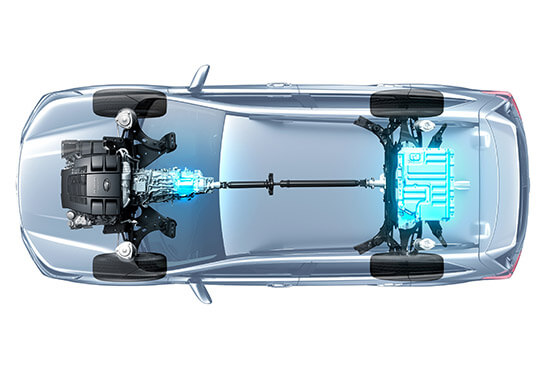
Conventional hybrid cars, which are often seen as a popular option for those interested in family cars, usesacombustion engine andanelectric motor(powered byelectricity stored in an internal battery)to drive the vehicle.The electric motor is more efficient at producing torque and as such, is generally usedto get the car moving. The combustion engine is more efficientwhen maintaining higherspeedsand generally takes overonce the car is moving.As a result, hybrid carscanprovide better fuel economyin comparison to similar petrol-only variants, because theytake advantage of the efficiencies of both motors.In certain conditions,they canbriefly runin electric-onlymode alone, briefly shutting off the internal-combustion engine and reducing its fuel use to zero, orthey can work simultaneouslyto reduce the load onthe petrol engine.There is noabilityto plug in and charge a conventional hybridvehicle. The battery is charged through regenerative braking or the combustion engine.
Plug-in hybrids (PHEVs)generallyhave larger battery packs thanconventional hybrid vehicles andallowfor the vehicle to be plugged in and charged,either at home or at a charging station. PHEVsallow for longer periods of electric-only driving in comparison to conventional hybrid vehicleswhile still allowing the vehicle to run on petrol, like an old-school combustion-enginedcar, for instances where the PHEVs batteryrun entirely flat.Electric cars, on the other hand, are powered exclusively by electricity. They do away with a traditionalcombustionengine entirely, swapping it for an electric motor(s)and a large battery pack that will needto be plugged in andcharged, in much the same way a fuel tank needs filling.
The benefit of hybrids
Theres a lot of folk who like the idea of an electric car but are still a little worried about their vehiclerunning out ofjuice, or they might be intimidated by family cars that plug into something likesome kind of giantkitchen appliance.
Hybrid cars offer peace of mind in that they are morefuel efficientthancomparablecombustion-engine-onlycars, but they also come with the long-distance reliabilitythanks to the ability to fill up at a petrol station.
Subaru has two all-wheel-drivehybridfamily cars on the market - the Forester SUV and the XV compact hybrid SUV - both offering economical fuel consumptionin comparison to their petrol-only counterparts, great low-end performance and stellar driving efficiency for those looking at buying a hybrid SUV.
Theyre the perfect meeting point between style,formand functionality.
CarsGuide
Paid Partnership
25 May 2021